admin
admin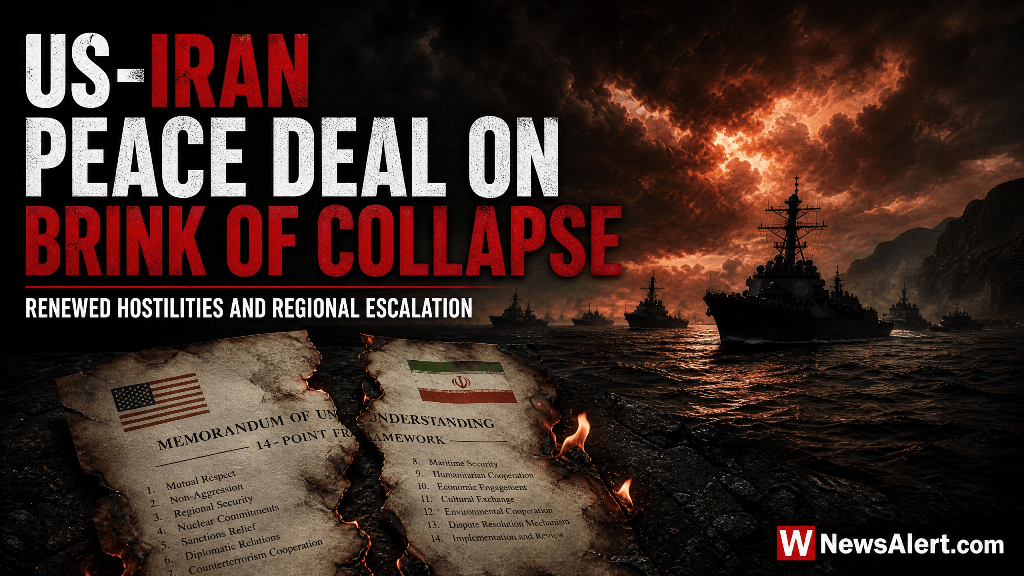
Executive Summary
The fragile peace agreement between the United States and Iran, which initially promised to end hostilities and reopen the Strait of Hormuz, is now on the verge of collapse. Recent developments, including renewed US strikes on Iranian targets, Iranian retaliation, and the re-closure of the Strait of Hormuz by Tehran, indicate a severe deterioration of the situation. Diplomatic efforts have faltered, with crucial talks in Switzerland being called off amidst escalating violence involving Hezbollah and Israel. This rapid unraveling of the peace initiative underscores the deep-seated mistrust and conflicting regional interests, pushing the Middle East back into a highly volatile state. Israel continues to vehemently oppose the deal, further complicating any path to de-escalation.
Main Analysis
Renewed Hostilities and the Teetering Hormuz Agreement
Just weeks after an initial memorandum of understanding aimed at de-escalating tensions, the US-Iran peace deal faces imminent failure. Reports confirm renewed US strikes on Iranian targets, met with swift Iranian retaliation, pushing the fragile Hormuz agreement to the brink . This resurgence of military action directly contradicts the spirit and terms of the initial ceasefire, highlighting the profound instability that continues to plague the region.
Strait of Hormuz Re-closure and Diplomatic Breakdown
A critical blow to the peace efforts came with Iran’s decision to re-close the strategic Strait of Hormuz. This move, reportedly in response to Israeli attacks on southern Lebanon, directly undermines global energy security and signals Tehran’s willingness to exert leverage through vital maritime chokepoints . Concurrently, crucial talks between the US and Iran, scheduled to take place in Switzerland for the implementation of the peace deal, were abruptly called off following an incident where Hezbollah killed four people . This diplomatic breakdown leaves little room for a peaceful resolution in the immediate future.
Israel’s Unwavering Opposition and Regional Implications
Israel’s leadership has consistently voiced strong opposition to the US-Iran peace deal, viewing it as a
“catastrophic capitulation” that fails to address Iran’s nuclear ambitions and regional proxy activities . The recent escalation, particularly Israel’s expanded assault in Lebanon and the subsequent Iranian-backed Hezbollah response, further validates Israel’s concerns and intensifies the regional conflict. The US-Iran deal, intended to bring stability, has instead exposed deeper fissures and heightened the risk of a wider conflagration.
Strategic Implications
The rapid deterioration of the US-Iran peace initiative has profound strategic implications. The return to military confrontation and the re-closure of the Strait of Hormuz will undoubtedly send shockwaves through global energy markets, potentially leading to increased oil prices and economic instability. For the United States, the failure of this diplomatic effort undermines its credibility as a mediator and complicates its broader Middle East strategy. For Iran, the renewed hostilities risk further international isolation and economic hardship. Most critically, the escalating conflict between Israel and Hezbollah, directly linked to the broader US-Iran dynamics, threatens to engulf the entire region in a devastating war. The current situation demands urgent international intervention to prevent a full-scale regional conflict, as the initial hopes for peace have been replaced by a dangerous return to the brink.
References
[2] Al Jazeera. “Iran war updates: Tehran shuts Hormuz, Vance on way to Switzerland.”
[3] The Guardian. “US-Iran talks abruptly called off after Israel and Hezbollah trade…”
[4] The New York Times. “Israel Stunned by Trump’s Iran Deal.”