admin
admin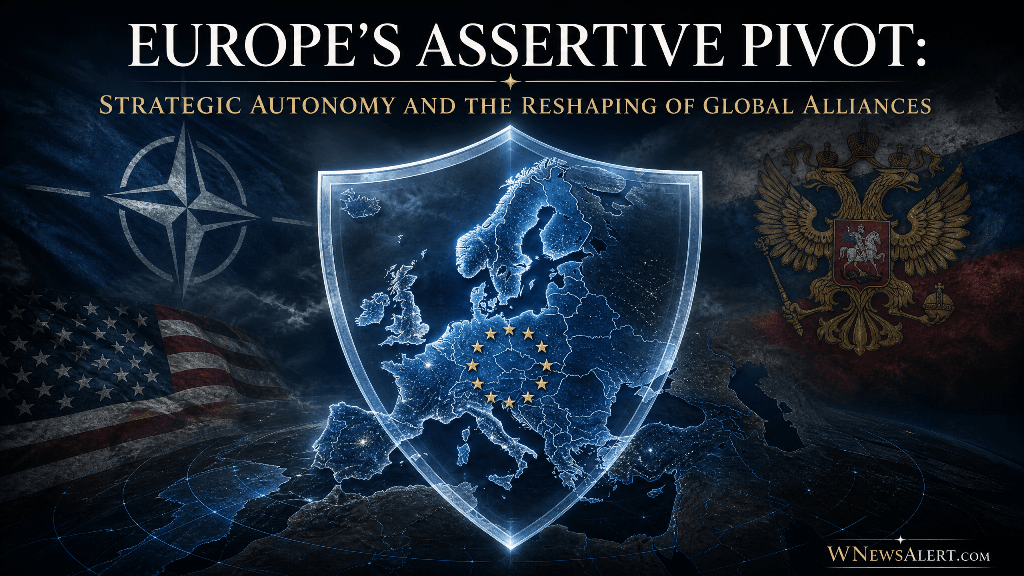
Executive Summary:
The European Council’s June 2026 summit underscored a decisive acceleration in the EU’s pursuit of strategic autonomy, a move driven by a confluence of factors including the protracted conflict in Ukraine, evolving transatlantic dynamics, and a more fragmented global order. This analysis explores the underlying motivations for this intensified push, examining how the EU’s ambition to enhance its defense capabilities and reduce reliance on external actors is poised to redefine its relationships with NATO, the United States, and Russia, ultimately impacting the delicate balance of global power. The shift signifies Europe’s determination to assert itself as a more independent and influential geopolitical force, moving beyond its traditional role.
Main Analysis:
1. The Genesis of Autonomy: Lessons from Ukraine and Transatlantic Shifts
The ongoing conflict in Ukraine has served as a potent catalyst for the EU’s strategic autonomy agenda. The initial reliance on U.S. military aid and leadership highlighted vulnerabilities in European defense capabilities, prompting a collective realization that greater self-sufficiency is imperative [1]. Concurrently, shifts in U.S. foreign policy, characterized by a growing focus on the Indo-Pacific and occasional questioning of NATO commitments, have fueled European concerns about the long-term reliability of transatlantic security guarantees [2]. This has spurred initiatives to bolster the European defense industrial base, foster joint procurement, and invest in next-generation defense technologies, aiming to create a more robust and independent security architecture.
2. Redefining NATO and the U.S. Relationship
The EU’s drive for strategic autonomy is not intended to undermine NATO but rather to strengthen its European pillar. A more capable and self-reliant Europe is seen as a stronger partner within the alliance, capable of shouldering a greater share of the collective defense burden [1]. However, this evolution inevitably introduces complexities. Washington’s ambivalence towards European unity, particularly concerning defense industrial cooperation, suggests a nuanced relationship where the U.S. seeks European contributions while guarding against perceived protectionism [3]. The challenge for the EU will be to navigate this delicate balance, ensuring its autonomy enhances, rather than detracts from, transatlantic solidarity.
3. Implications for Russia and Global Power Dynamics
For Russia, a strategically autonomous EU presents a more formidable and unified front. A Europe less dependent on external security guarantees and with enhanced defense capabilities reduces Moscow’s leverage and complicates its geopolitical calculations [4]. The EU’s concerted efforts to diversify energy sources and strengthen economic resilience further diminish Russia’s capacity for coercive diplomacy. This shift contributes to a broader rebalancing of global power, where the EU aims to project its influence more independently, potentially challenging the traditional bipolar or unipolar frameworks and fostering a more multipolar international system.
Strategic Implications:
The accelerated pursuit of EU strategic autonomy marks a pivotal moment in international relations. It signals a profound recalibration of Europe’s role, moving towards greater self-reliance in security and defense. While intended to complement NATO, this trajectory will necessitate careful management of transatlantic relations to avoid friction. For Russia, it implies a more resilient and unified European adversary. Ultimately, a more autonomous EU will be a significant factor in shaping the future global power balance, advocating for a multilateral order where Europe plays a more assertive and independent role.
References:
[1] European Council. (2026, June 18-19). European Council, 18-19 June 2026. https://www.consilium.europa.eu/en/meetings/european-council/2026/06/18-19/ [2] esthinktank.com. (2026, April 9). Post-American Europe: strategic autonomy and the transformation of the transatlantic relationship. https://esthinktank.com/2026/04/09/post-american-europe-strategic-autonomy-and-the-transformation-of-the-transatlantic-relationship/ [3] gmfus.org. (2026, March 2). Rearming for the Future. https://www.gmfus.org/news/rearming-future [4] gisreportsonline.com. (2026, January 20). Seeking strategic autonomy in a fragmenting world. https://www.gisreportsonline.com/r/strategic-autonomy-3/