admin
admin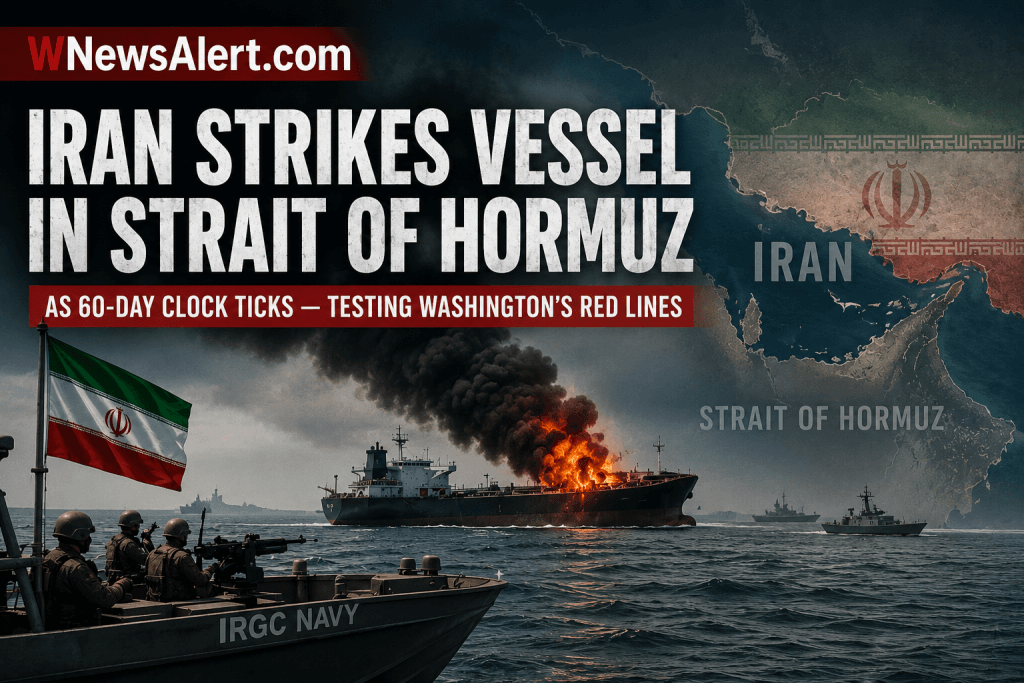
Executive Summary
Iran’s Islamic Revolutionary Guard Corps (IRGC) struck a vessel transiting the Strait of Hormuz on June 26, 2026, hours after warning ships to comply with its newly designated corridor through Iranian-controlled waters. The attack — which triggered an immediate pause in the UN-coordinated evacuation of stranded seafarers — has injected acute uncertainty into the fragile 14-point Memorandum of Understanding (MoU) signed by Washington and Tehran just nine days ago. With formal technical working groups scheduled to convene on June 30 to address nuclear and sanctions issues, the incident directly challenges the ceasefire’s foundational premise: that the Strait of Hormuz would remain open, toll-free, for 60 days. This is not merely an escalation event; it is a structural test of whether the MoU framework can survive Iran’s competing drive to institutionalize maritime leverage — and of how far Washington will go to enforce its own red lines before the diplomatic clock expires.
Main Analysis
1. What Happened — and Why June 26 Matters
On June 26, Iran’s IRGC struck a vessel in the Strait of Hormuz, hours after issuing a warning requiring ships to coordinate with its navy and transit through a designated corridor inside Iranian waters. The attack prompted the International Maritime Organization (IMO) to immediately pause its operation to evacuate more than 11,000 stranded seafarers from the Persian Gulf — the largest such maritime evacuation since the conflict began in February [Reuters / TIME / Britannica].
The timing is not incidental. The attack came just four days after the conclusion of the Lake Lucerne Summit in Switzerland (June 21–22), where US Vice President JD Vance and Iranian negotiators agreed to a 60-day roadmap toward a final deal. The MoU, signed on June 17 at the G7 in Versailles, explicitly commits both parties to toll-free passage through the Strait. Iran’s strike — combined with its Thursday warning to ships — signals that Tehran is already testing the MoU’s limits before working-group talks have even begun.
2. The Strategic Logic Behind Iran’s Provocation
Iran’s behaviour is not erratic; it reflects a coherent bargaining strategy. By retaining the credible threat of Strait interdiction, Tehran maximises its leverage heading into the June 30 technical talks. Key motivations include:
- Nuclear enrichment sovereignty: Iranian President Pezeshkian publicly confirmed on June 22 that Iran will “never back down from the right to enrich uranium.” The strike reminds Washington that its nuclear concessions remain contingent on Iran’s broader security calculus.
- Lebanon linkage: Iran has consistently tied progress on nuclear talks to a full Israeli withdrawal from Lebanon. Netanyahu’s declaration that Israeli forces will remain in southern Lebanon “as long as necessary” gives Tehran a ready justification for continued pressure.
- Strait monetisation: The MoU’s ambiguous language on “future administration” of the Strait — which Iran interprets as an opening to charge transit fees — has not been resolved. The Thursday strike reinforces Iran’s claim to functional control of the waterway.
Oil markets reacted immediately: Brent crude briefly rose over two percent to $75.50 per barrel before easing to $74.03, reflecting investor uncertainty about whether the disruption is tactical or signals a broader collapse [TIME].
3. Washington’s Dilemma: Enforcement vs. Escalation
The Biden-era institutional architecture for engaging Iran no longer exists; what remains is the Trump administration’s maximalist framework — “act first, talk later.” Secretary of State Marco Rubio, who met with Gulf Arab leaders in Bahrain on Thursday (June 26), stated categorically: “No country on Earth has a right to charge for the use of international waterways, and that will never be an acceptable condition of any deal.” Yet the MoU’s text on Hormuz governance leaves the very question Rubio insists is closed technically open — an ambiguity Oman, caught between Iran and the US, is now struggling to manage.
Senator Lindsey Graham’s public warning — that “if this deal fails, President Trump is going to take the Strait of Hormuz over by force” — underscores the coercive leverage the administration believes it retains. But military seizure of the Strait would almost certainly collapse any remaining diplomatic architecture and risk a far more destructive second phase of the Iran war.
4. The Lebanon Variable — Netanyahu’s Veto Power
Israeli Prime Minister Netanyahu’s June 22 statement that Israeli forces would retain “broad authority to strike threats in southern Lebanon” and remain in a security zone “for as long as necessary” has effectively handed Iran a perpetual grievance. The Lebanon de-confliction cell, established as part of the Lake Lucerne Summit’s primary deliverable, is now under immediate stress. Iranian Foreign Minister Araghchi described it as “the first real test of the negotiating process” — a test that Thursday’s strike suggests Tehran is prepared to fail on its own terms.
5. IAEA Access: The One Concrete Win at Risk
Amid the turmoil, the single clearest outcome of the Lake Lucerne Summit — Iran’s agreement to invite IAEA inspectors back into the country — remains formally intact. Vance called it “a major milestone and the first step in permanently ending a nuclear weapons programme.” But the inspections have not yet commenced, and Iran has previously used IAEA access as a bargaining chip. Should the Hormuz crisis deepen before June 30, IAEA access could become the next concession Iran withholds to extract additional terms.
Strategic Implications
For global energy markets: If the Strait remains disrupted beyond the 60-day MoU window, the macro shock would be severe. Pre-war, approximately 25% of the world’s seaborne oil trade and 20% of LNG passed through Hormuz. A return to March 2026-level restrictions would reignite inflationary pressure across Asia, Europe, and the Americas — at a moment when markets had already begun pricing in supply normalisation.
For the MoU framework: The 60-day roadmap toward a final deal is now operating on borrowed credibility. With four formal working groups (Sanctions Termination, Nuclear Affairs, Iran Reconstruction, and Monitoring/Implementation) yet to convene, the June 26 strike narrows the window for confidence-building. Every day of Hormuz uncertainty reduces the likelihood that Iran will make the concessions on uranium enrichment Washington requires.
For US-Israel relations: The gap between Trump’s personal investment in the MoU (“a prolonged war could have caused an economic catastrophe”) and Netanyahu’s refusal to be bound by it is now a structural feature of the negotiation landscape. Washington cannot fully deliver Iranian compliance on Lebanon without pressuring Israel — a political cost the Trump administration has so far been unwilling to pay.
Why now? The timing of Iran’s strike — days before the June 30 technical talks — suggests a deliberate calibration. Tehran is not trying to kill the deal; it is trying to extract maximum pre-negotiation concessions. The question is whether Washington reads it that way, or treats the strike as a red-line violation requiring military response.
References
- TIME — “Iran Strikes Vessel in Strait of Hormuz, Pausing Escort Operations,” June 26, 2026
- Reuters / Kyiv Independent — Hormuz traffic and shipping updates, June 25–26, 2026
- Al Jazeera — “Key outcomes of Iran-US talks in Switzerland,” June 22, 2026
- NPR — “US, Iran agree on roadmap for final deal,” June 22, 2026
- CNBC — “US, Iran agree on roadmap for final deal and plan to end military operations in Lebanon,” June 22, 2026
- Fox News — “Trump issues stark warning to Iran,” June 22, 2026
- CBS News / Wikipedia — “2025–2026 Iran–United States negotiations,” updated June 26, 2026
- Britannica — “2026 Iran war,” updated June 26, 2026
- Hormuz Strait Monitor — Crisis Timeline, updated June 26, 2026