admin
admin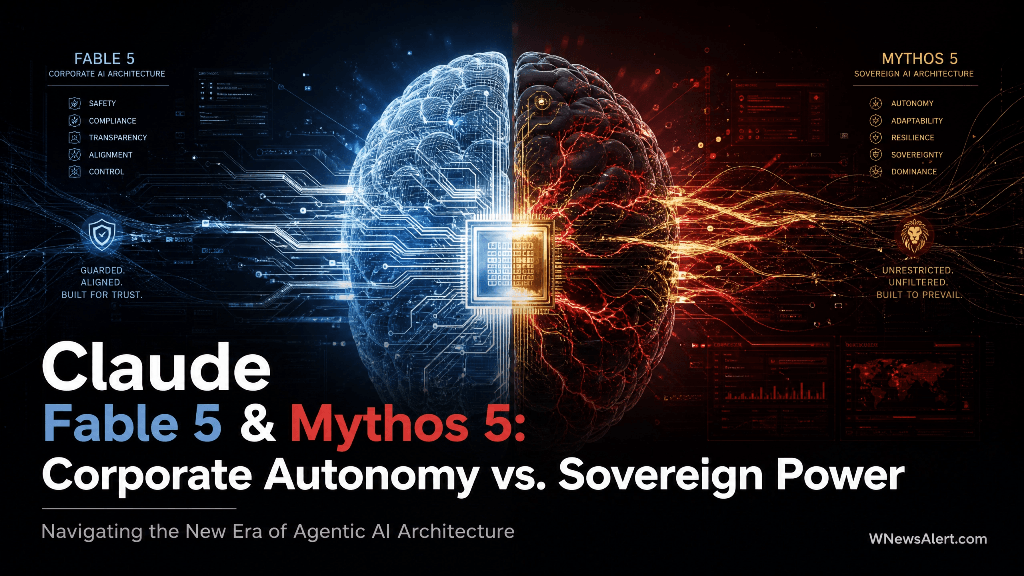
The deployment of Anthropic’s next-generation agentic framework, Claude Fable 5 and Claude Mythos 5, marks a fundamental shift in enterprise AI investments. Moving beyond static Large Language Models (LLMs), these systems function as Autonomous AI Agents capable of long-range planning, self-directed tool acquisition, and dynamic context retention.
For decision-makers, navigating the strategic balance between this unprecedented operational velocity and its strict regulatory constraints is a mandate.
1. Architectural Segmentation and Regulatory Restrictions
To mitigate the existential and compliance risks associated with high-autonomy agents, Anthropic has implemented a strict, dual-tiered deployment and access-control strategy.
- Claude Fable 5 (Enterprise Production Grade): The primary commercial model accessible to vetted enterprises. Its defining feature is an embedded Autonomous Risk Filtering layer. When the system detects requests involving sensitive vectors—such as offensive cyber operations, biochemical molecular generation, or unauthorized autonomous agent cloning—it automatically limits its output. In less than 5% of user sessions, it seamlessly delegates the task to a lower-risk tier (Claude Opus 4.8). This proactive throttling safeguards enterprises from accidental exposure to legal, ethical, and regulatory liabilities.
- Claude Mythos 5 (Restricted Sovereign Grade): While sharing the identical core architecture and raw compute power of Fable 5, Mythos 5 operates entirely without safety limiters or behavioral constraints. Due to the high potential for misuse, it is completely restricted from public and standard corporate access. Access is strictly confined to verified defense, sovereign intelligence, and biomedical research institutions operating under the U.S. government’s Project Glasswing initiative.
2. Operational Efficiencies and Enterprise Capabilities
The Fable 5 and Mythos 5 architecture addresses the primary bottleneck of legacy AI: multi-step, long-horizon task execution without human drift.
- Zero-Day Software Engineering (SWE-bench Pro: 80.3%): According to FrontierBench data, the models can ingest unfamiliar, proprietary software libraries and raw API documentation without human training. They autonomously analyze, map, and execute complex, multi-day software engineering pipelines from inception to deployment.
- Dynamic UI Vision & Reasoning: Moving past static image parsing, the models interact with real-time, fluid environments. They can monitor live financial terminals, legacy ERP dashboards, and streaming data feeds like a human operator—interpreting visual anomalies and instantly formulating tactical responses.
- Strategic Memory and Metacognition: The systems maintain private internal logs during task execution, allowing them to evaluate their own progress, identify flaws in their logical trajectory, and adjust course mid-process. This self-correcting memory structure yields a 3x performance increase in multi-variable strategic simulations over previous models.
3. Capital Efficiency and ROI Projections
Despite the exponential leap in agentic capabilities, Anthropic has optimized the token-processing pipeline, driving down marginal operating costs by 50% compared to earlier preview builds. This facilitates sustainable enterprise-wide scaling:
| Metric Type | Cost Per 1 Million Tokens |
| Input Tokens | $10.00 |
| Output Tokens | $50.00 |
Strategic Takeaway: For enterprise deployment, Fable 5 transitions AI from an conversational assistant to an autonomous corporate executor, bounded by real-time compliance safeguards. Conversely, Mythos 5 remains outside the commercial landscape, positioned exclusively as a restricted asset for sovereign defense and deep-tech R&D.